After wild animals, rainforests, thorny savannas, and lava flows, two adventurous friends bring back the answer to a question that has spanned centuries: Is there snow on Kilimanjaro?
Landing at Kilimanjaro Airport. Kili (for those in the know) hides behind a blanket of thick, cottony clouds. On Kibo, the highest of the massif’s three craters, our goal is Uhuru’s Peak (the peak of freedom), which culminates at 5,896m, the highest point. Among the various routes to the summit, we chose the Machame route, which promises the most beautiful variety of landscapes, from the jungle of Machame Gate (the national park gates) to the lava of the summit crater, with a return via Mweka to avoid lingering during the descent. This is the mandatory descent route for all those taking the Machame route, to relieve congestion on the normal, very busy Marangu route. In addition, it’s the route that allows for the most gradual acclimatization to altitude.
After nine hours on a bus speeding along a bumpy road without shock absorbers, we arrived in Marangu, a village located a good hundred kilometers from Kilimanjaro, with our backs aching. At base camp, we were immediately greeted by Simon, our expedition leader, who quickly briefed us on the trip’s itinerary.
The next day at 10 AM, we crammed into a minibus with the guide, porters, cook, and all the gear, heading towards the reserve gates. We stopped in Machame, a small village at 1600m altitude, where our approach march would begin. The guide chose the last porters from the crowd of hopefuls vying for our bags. The cook took the opportunity to stock up on the last provisions we would need. Half an hour later, we crossed coffee and banana plantations before plunging into a thick, humid, and muddy jungle.
We reached the park entrance hut. A ranger, all muscles and dark glasses, was waiting for us. Name, first name, age, address… Passport! He looked about as cool as a Serbian customs officer… Without cracking a smile, he meticulously inspected all our luggage. Simon had warned us that the guards are more than vigilant to ensure the protection of Tanzania’s most important conservation park. It’s strange, but even if we had nothing to hide, we still felt guilty about something. It was only after he checked the last package and exchanged a few words in Swahili with Simon that the atmosphere relaxed a bit. The guard asked us to sign the great book of Kilimanjaro, relieving us of $410 each for the entrance fees corresponding to our six-day trek.
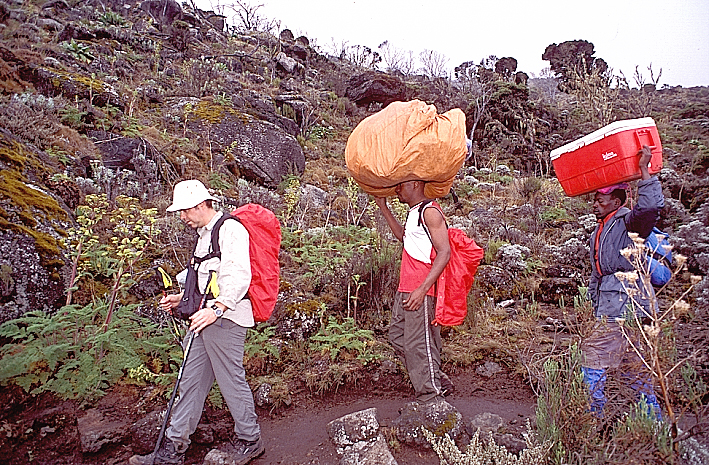
We set off again into the humid heat of the jungle. The 4×4 track continued as a semblance of a path that disappeared into the lush vegetation. We struggled to move forward, soaked to the bone by the omnipresent humidity, with mud up to our ankles. The porters, however, progressed calmly in flip-flops with our bags on their heads. After three hours spent laboriously battling through the mud that insidiously seeped into our hiking boots, making us regret our yellow rubber boots (which we would have been ashamed to wear in other circumstances), the mist cleared, giving us glimpses of dense, magical jungle. After six hours of walking, we arrived exhausted at Machame Hut, the first camp. It was barely seven in the evening when night abruptly fell on us. And with it, the temperature, which playfully dropped close to zero… We barely had time to pitch the tent and make a fire for dinner.
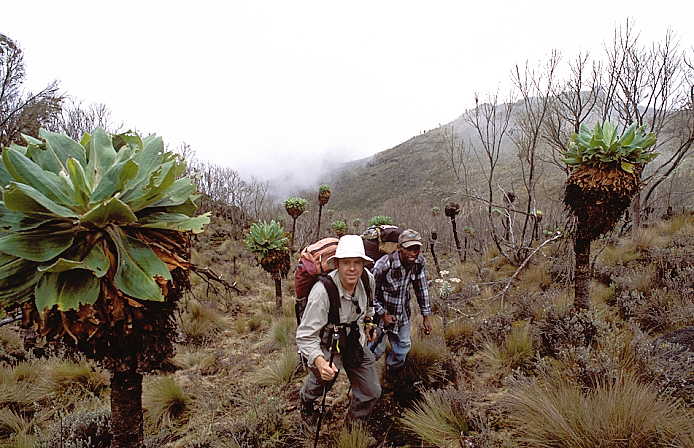
The next day, the jungle gave way to giant heather, which shrank as we gained altitude. Fortunately, we had finally found our rhythm, and everyone was now moving with a confident and quick pace. When we arrived at Shira Hut camp, perched at 3,800 meters altitude, only a few giant plants remained here and there, but the vegetation had almost disappeared.
After a restless night, we poked our noses out of the tents again. And there, to our surprise, the camp was covered with a thin layer of snow. It was -5°C. Suddenly, the clouds evaporated under the sun’s rays, which had just passed over Kili. The snow melted almost instantly, and the temperature rose to 20°C in a few minutes. The porters emerged one by one. Far above us, the summit of Kilimanjaro sparkled under the equatorial sun. Mount Meru, Tanzania’s second-highest peak at 4,566m, emerged like a rounded nipple from the sea of clouds nestled in the valley.
But the steep view of Western Breach Wall reminded us that we were still far from our goal, so we decided to stay one more night here to better acclimatize before tackling the summit. Next stop: Lava Tower, the penultimate camp at 4,600m altitude. With a tomato and cucumber sandwich with strawberry jam in our stomachs (a weakness of the English, it seems!), we hit the road again over frozen lava flows. In the middle of this lunar and desolate landscape, a few animal carcasses lay on the ground, reinforcing the impression of desolation emanating from these places. My telescopic poles kept retracting every time I leaned on them, and each time I nearly fell flat on my face. So, I was forced to adjust them while walking, and since I wasn’t watching where I was going, I dangerously stumbled over the lava rocks. After four hours of struggling with my poles, we finally approached the camp established at the foot of a large lava column (hence its name, Lava Tower). We were very close to the crater glaciers, and a glacial wind swept through the area. Luckily, we found a small cave that proved to be a perfect shelter for pitching the tent. After five days without washing, we felt like we were in Quest for Fire. The nights were getting harder and harder, and I started to feel the first symptoms of altitude sickness: slight nausea and a budding headache. Without further ado, I took the famous mountain sickness medication prescribed by my doctor before departure. And… Miracle, it worked! I know I’m lucky because some are forced to turn back because of it. In fact, one of our porters wouldn’t escape it and would have to descend the next day.
The last camp, Arrow Glacier, is only 250 meters from here, but at 4,850m altitude, oxygen becomes scarcer, and each step feels heavy, slow, and exhausting. At this altitude, we gain about 250 meters of elevation per hour. And believe it or not, we are already 43 meters above Mont Blanc!
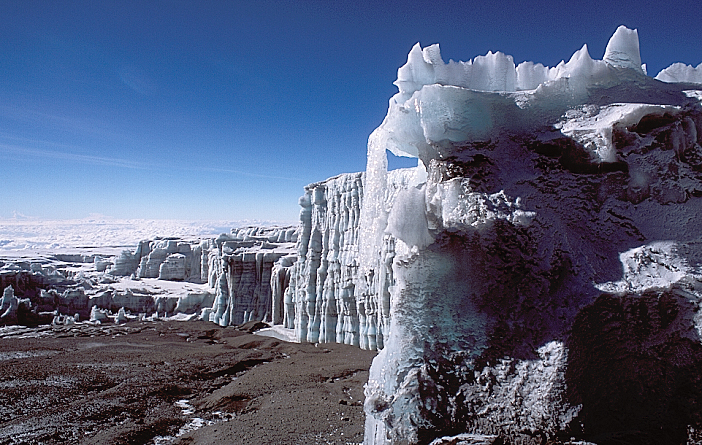
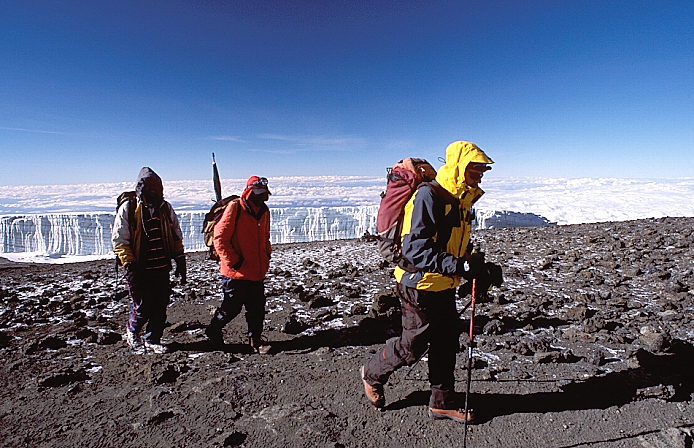
Midnight, the alarm clock rings, and we’d love to smash it. It’s time to leave under a beautiful starry sky, our brains a little numb from the last few short nights. But after some tea and dry biscuits, we’re fully energized again to begin our final ascent to the summit. We only take the bare minimum with us. The porters will transport the rest of our belongings after circling the crater to meet us on the descent route. Arriving at the edge of the great crater at 5,800m altitude, the first rays of sun finally break through. Our footsteps disappear into a thick layer of ash that gives off a charming smell of sulfur. My breathing is increasingly difficult. Exhausted, I finally collapsed my poles into my bag, and I now force myself to put one foot in front of the other without thinking, as if nothing could stop me from moving forward. In my daydreams, I think I can make out my friends’ encouragement. Suddenly, resting on the black dust, an immense table of ice appears before us. The scenery is totally unreal, but there really is snow on Kilimanjaro!
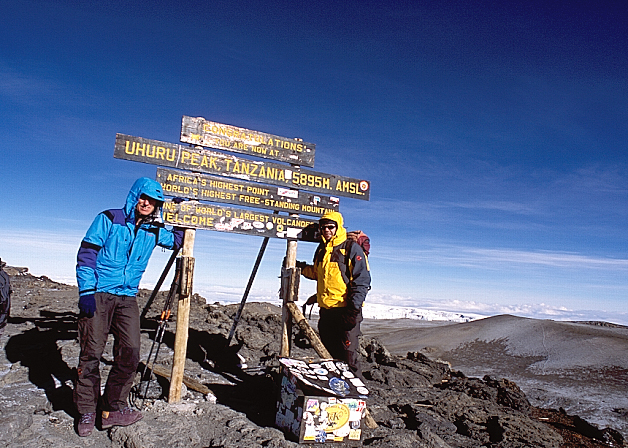
But Uhuru’s Peak awaits us a hundred meters higher, and we can’t linger. Crossing the crater proves more difficult than expected. We advance step by step in the frozen morning air that paralyzes even our thoughts. Finally, at 12:30 PM, after almost giving up a good ten times, we claim our victory on the roof of Africa at 5,895m altitude. And at our feet, all the splendor of the African savanna…
By Marie LABORIE / RAPSODIA Agency
Why go:
1- To climb the highest peak on the African continent (nearly 6,000m).
2- To successively play the part of “Gorillas in the Mist”, “Out of Africa”, and “Quest for Fire”.
3- For the excitement of an expedition in the jungle and savanna where wild animals lurk.
4- For the encounter with an enchanting people and the exceptional beauty of African landscapes.
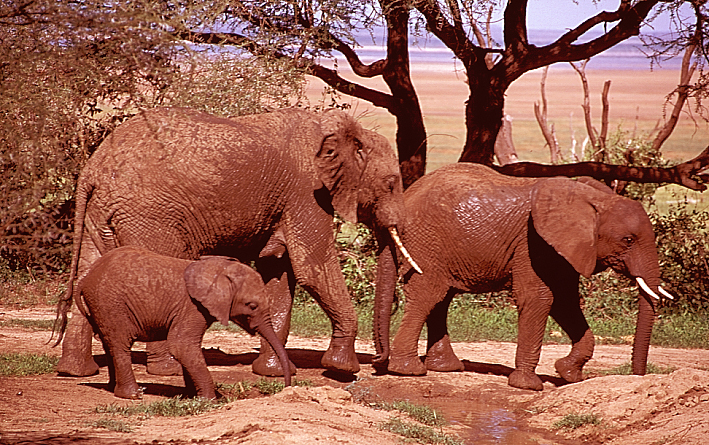
5- To get up close to the most beautiful animals of the African savanna during a photo safari.
Practical Info:
NB: Individual trekking on Kilimanjaro is prohibited; it is mandatory to use the services of an accredited agency.
Where to sleep: In your tent and in the huts along the different routes…
Where to eat: On a flat rock with your picnic… There are no high-altitude restaurants…
Seasons: 2 rainy seasons to absolutely avoid: mid-October to mid-December and mid-March to mid-June. The best time is from late June to early October.
Routes: The ascent of Kili presents no technical difficulty, apart from acclimatization to high altitude.
Several access routes, more or less difficult, are listed. Marangu, Machame, Mweka, and Umbwe are the best known and bear the names of the villages where the main entrances to Kilimanjaro National Park are located:
-The Marangu route is the classic itinerary, dotted with huts and very popular.
-The Machame route is the most beautiful and most gradual.
-The Umbwe and Rongai routes are steeper and more slippery.
-The Shira route is longer but beautiful.
Budget:
Allow 2,000 to 2,500 euros for two weeks, including flight, climbing fee, and a few days on safari.
Flight:
9 to 10 hours flight from France: Air France, KLM, British Airways…
Around 800 euros for a round trip
Europe – Kilimanjaro Airport on a regular line.
Time difference from France: +2h in winter and +1h in summer.
Health:
Necessary update of standard vaccinations: tetanus, polio, tuberculosis, diphtheria, typhoid.
Yellow fever vaccination is mandatory for Tanzania, and you theoretically need to carry your international vaccination certificate. Diamox: symptomatic medication for mountain sickness by prescription.
Providers: All reputable trek agencies offer Kilimanjaro ascent!
Useful:
Mandatory visa for Tanzania: 35 euros. Bring your passport, 1 identity photo, your flight ticket or travel certificate.
Embassy of the United Republic of Tanzania: 13, avenue Poincaré 75016 Paris. tel 0153706366 fax 0147550546 e-mail info@amb-tanzanie.fr